


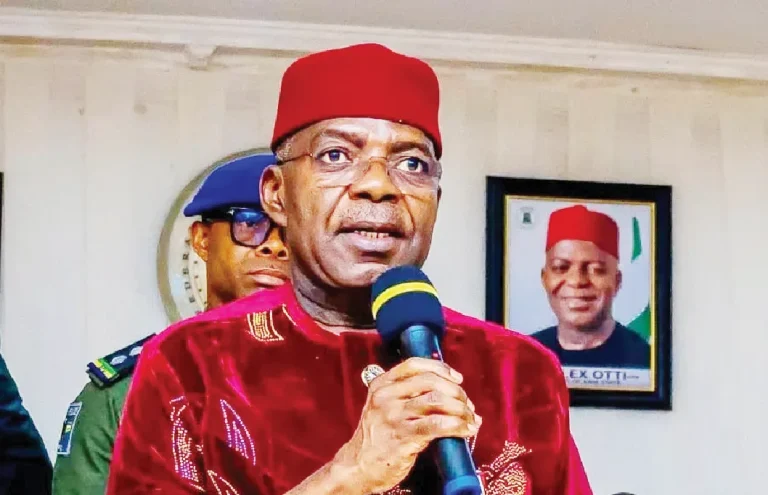
Abia Debt Stock Drops to ₦48.6bn – Otti Says Government Has Paid Off ₦98.6bn
Abia State Governor, Alex Otti, has announced that the state’s reported debt stock has fallen from ₦147.2 billion in the second quarter of 2023 to ₦48.6 billion in the corresponding period of 2026. The governor attributed the reduction to debt repayments, while explaining that the earlier figure did not include some outstanding liabilities, including pension obligations and salary arrears.
Abia State Governor, Dr Alex Otti, has disclosed that his administration has reduced the state’s reported debt stock to ₦48.6 billion, representing a significant decline from the ₦147.2 billion recorded in the second quarter of 2023.
The governor made the disclosure during the October edition of his monthly media chat, tagged Dr Alex Otti Speaks to Abians, where he addressed questions concerning the state’s financial position, debt repayment, foreign loan obligations and the government’s approach to borrowing.
According to Otti, the state’s reported debt stock declined by ₦98.6 billion between the second quarter of 2023 and the corresponding period of 2026.
The governor explained that the ₦147.2 billion figure represented the debt profile captured by the Debt Management Office (DMO) at the time, but did not include some outstanding obligations, particularly pension liabilities and salary arrears that were not reported to the agency.
He said the reduction to ₦48.6 billion showed that his administration had paid off more than ₦90 billion in reported debt obligations since taking office in 2023.
Otti’s announcement comes amid public discussions about government borrowing, debt servicing and the financial responsibilities inherited by state administrations across Nigeria.
The governor also addressed reports suggesting that Abia State’s foreign debt obligations had increased, explaining that the development was connected to the disbursement of funds under existing multilateral financing arrangements rather than new direct borrowing by his government.
He specifically mentioned the Abia State Integrated Infrastructure Development Project (ABSID) and the Rural Access and Agricultural Marketing Project (RAAMP) as examples of the financing arrangements involved.
Otti maintained that his administration had not undertaken direct borrowing so far, although he did not rule out the possibility of obtaining loans in the future if they became necessary to finance productive projects capable of generating long-term benefits.
The governor’s comments have placed Abia’s debt management strategy back in the spotlight, particularly as residents and financial observers continue to examine the relationship between debt repayment, infrastructure development and public spending.
Abia’s Debt Falls From ₦147.2bn to ₦48.6bn
Providing details of the state’s financial position, Governor Otti said Abia’s reported debt stock stood at ₦147.2 billion in the second quarter of 2023.
He compared the figure with the ₦48.6 billion recorded in the second quarter of 2026, describing the difference as evidence that substantial repayments had been made.
The difference between the two figures is ₦98.6 billion.
This represents a reduction of approximately 67 per cent in the reported debt stock over the period under review.
Otti said the reduction was achieved through the government’s efforts to meet outstanding financial obligations and manage the state’s resources.
He explained that the initial debt figure did not capture every liability inherited by his administration.
According to him, some obligations, including unpaid pensions and salary arrears, were not included in the figure reported to the Debt Management Office.
The governor stated during the media chat:
“As at Quarter 2, 2023, we were at N147.2bn, and that did not include debts that were not reported to the DMO, like pensions and salary arrears. But as at Quarter 2, 2026, that number has declined to N48.6bn. That means more than N90bn has been paid off.”
His explanation suggests that the reduction in the reported debt stock should be understood within the context of the liabilities captured in the figures being compared.
The announcement does not mean that every financial obligation inherited by the state has necessarily been cleared. Rather, the governor was referring to the reported debt figures for the two periods.
A comprehensive assessment of the state’s financial position would also require details of outstanding pension obligations, salary arrears, contractor liabilities and other commitments that may not be reflected in the headline debt figure.
Nevertheless, the difference between ₦147.2 billion and ₦48.6 billion represents a substantial reported decline and provides an important basis for examining the state’s debt management efforts.
Otti Explains Why the Inherited Debt Was Higher Than the DMO Figure
One of the major points raised by Governor Otti during the media chat was the distinction between the debt figure officially captured by the Debt Management Office and the wider financial obligations inherited by his administration.
The DMO is responsible for collecting, managing and publishing information about Nigeria’s public debt, including the domestic debt of state governments and external debt obligations.
However, the governor said the ₦147.2 billion figure recorded in the second quarter of 2023 did not include certain liabilities that existed when his administration assumed office.
He specifically mentioned pension obligations and salary arrears.
These are important financial commitments because state governments may have outstanding responsibilities to retired public servants, serving workers and other beneficiaries.
Pension obligations arise from retirement benefits that government is expected to pay to eligible former employees.
Salary arrears, on the other hand, represent unpaid wages and other employment-related entitlements owed to workers.
Such obligations can place pressure on government finances even when they are not reflected in a particular public debt figure.
Otti’s clarification therefore highlights the difference between a reported debt stock and the broader financial responsibilities that an administration may inherit.
For residents seeking to understand the state’s financial position, the distinction is important.
A government may report a reduction in its recorded debt while still having other outstanding liabilities that require attention.
This is why a complete financial assessment should consider not only loans and other debt instruments but also unpaid obligations, pension commitments, contractor payments and other outstanding claims.
The governor’s comments provide an explanation of how his administration views the inherited financial position of Abia State.
However, a detailed reconciliation of the different categories of liabilities would help the public understand the full extent of the state’s financial obligations.
Governor Says More Than ₦90bn Has Been Paid Off
Otti described the reduction in Abia’s reported debt stock as evidence that his administration had made substantial repayments since assuming office in 2023.
Based on the figures he presented, the state moved from a reported debt stock of ₦147.2 billion in the second quarter of 2023 to ₦48.6 billion in the second quarter of 2026.
The difference amounts to ₦98.6 billion.
The governor described the amount as more than ₦90 billion paid off.
Debt repayment is an important part of public financial management because excessive borrowing can limit the resources available for other government responsibilities.
When a state has significant outstanding loans, part of its revenue may be required to meet interest payments and principal repayments.
This can reduce the amount available for infrastructure, education, healthcare, security, environmental management and other public services.
Reducing outstanding debt may therefore create more room for government spending, depending on the state’s revenue, repayment schedule and other financial commitments.
However, debt reduction alone does not automatically establish that a government’s finances are sustainable.
A complete assessment would also examine how much revenue the state generates, how much it receives from federal allocations, the cost of servicing remaining debt and the amount spent on recurrent and capital projects.
The quality of public spending is equally important.
A state may borrow responsibly to finance infrastructure that supports economic activity, while excessive borrowing for projects that do not generate sufficient public value may create long-term financial pressure.
Otti said his administration’s approach was to manage resources effectively and avoid unnecessary direct borrowing.
His latest disclosure has consequently drawn attention to the balance between repaying existing obligations and financing development projects.
Otti Responds to Reports of Increased Foreign Borrowing
During the media chat, the governor also addressed reports suggesting that Abia State’s foreign debt obligations had increased.
The issue is significant because a reduction in the state’s overall reported debt figure may appear inconsistent with reports of additional foreign loan disbursements.
Otti explained that the development was largely connected to funds being drawn from existing multilateral loan arrangements.
He mentioned two projects in particular: the Abia State Integrated Infrastructure Development Project and the Rural Access and Agricultural Marketing Project.
According to the governor, funds were being accessed under these arrangements, which contributed to the figures being reported as foreign debt obligations.
He said:
“I am sure you have seen a report that said we have increased our loan book in terms of foreign borrowing. I believe it is the ABSID that we have drawn down, and then some other multilateral loans, including the RAAMP, that are being drawn down.”
The explanation draws attention to an important difference in public finance: an increase in the amount of funds disbursed under an existing loan facility does not necessarily mean that a government has entered into an entirely new borrowing arrangement.
A multilateral financing facility may be approved for a particular development project, with funds released in stages as the project progresses and agreed conditions are met.
When a state government draws down money under such an arrangement, the disbursed amount becomes relevant to its outstanding debt obligations.
The funds may be used to finance infrastructure, agriculture, rural access roads or other development programmes, depending on the purpose of the facility.
However, the fact that a loan is linked to a development project does not remove the government’s responsibility to repay it.
Borrowed funds remain financial obligations, and the public has a legitimate interest in knowing how much has been disbursed, what projects have benefited and the repayment conditions.
Otti maintained that the foreign debt figures being discussed should be understood in the context of existing financing arrangements.
What Is the Abia State Integrated Infrastructure Development Project?
The Abia State Integrated Infrastructure Development Project, commonly referred to as ABSID, is one of the multilateral financing arrangements mentioned by Governor Otti.
The governor referred to funds drawn down under the project while responding to concerns about the state’s foreign loan obligations.
Infrastructure development is an important component of state economic planning because roads, drainage systems and other public facilities can influence commercial activity and the movement of people and goods.
In a state such as Abia, where Aba is widely recognised for its manufacturing, trading and entrepreneurial activities, infrastructure is closely connected to the ability of businesses to operate efficiently.
Poor roads can increase transportation expenses, damage vehicles and delay the movement of raw materials and finished products.
Inadequate drainage can also affect residential areas, markets and industrial locations, particularly during periods of heavy rainfall.
Infrastructure projects are therefore often presented as investments intended to improve economic productivity and living conditions.
However, the success of any development financing arrangement depends on the quality of implementation.
The public needs information about the amount approved, the amount disbursed, the projects covered, the contractors involved, the implementation timetable and the expected benefits.
It is also important to know how the projects will be maintained after completion.
Where a project is financed through borrowing, its long-term value should be considered alongside the cost of repayment.
Otti’s reference to ABSID forms part of his explanation of why foreign debt disbursements may appear in the state’s financial records even though he says his administration has not undertaken direct borrowing.
RAAMP Also Mentioned in Abia’s Foreign Debt Explanation
Another financing arrangement mentioned by the governor was the Rural Access and Agricultural Marketing Project, known as RAAMP.
The project is connected to rural access and agricultural marketing, two areas that can influence the economic activities of rural communities.
Access roads are important to farmers because they provide connections between farming communities, markets, processing centres and distribution networks.
Where rural roads are in poor condition, farmers may experience difficulties transporting produce, particularly during the rainy season.
Transportation problems can increase the cost of moving agricultural products and contribute to delays, spoilage and reduced earnings.
Improved rural access can help connect producers with buyers and make it easier for agricultural goods to reach larger markets.
It can also support access to schools, health facilities and other public services in communities that are located far from major urban centres.
RAAMP is therefore relevant to discussions about infrastructure and agricultural development.
However, the financial implications of the programme must also be considered.
If funds are disbursed under a loan arrangement, the state must account for the obligations attached to the financing.
Information about the amount drawn down, the projects completed and the repayment terms would help residents assess the programme’s contribution to the state’s development priorities.
Otti’s comments indicate that the disbursement of funds under RAAMP contributed to the foreign borrowing figures that had attracted public attention.
Otti Says His Administration Has Not Undertaken Direct Borrowing
Addressing the issue of new loans, Governor Otti maintained that his administration had not undertaken direct borrowing so far.
He explained that the funds being drawn down under existing multilateral arrangements should not be confused with a new direct borrowing decision by the government.
The governor said:
“So far, there is no direct borrowing by the government. But that doesn’t mean we won’t borrow if it becomes absolutely necessary. We will borrow for regenerative projects, at the right time.”
His statement suggests that the administration intends to maintain a cautious approach to borrowing while retaining the option of obtaining financing when necessary.
The distinction between direct borrowing and drawing down funds from an existing facility is important when examining public debt.
A government may enter into a financing arrangement for a specific project, after which funds are released in stages.
The government may also obtain a new loan through a separate borrowing decision.
Both situations can affect public debt, but the circumstances and approval processes may differ.
For residents and financial observers, the most important issues include the total amount borrowed or disbursed, the purpose of the funds, the interest rate, repayment period and the expected economic benefits.
Otti’s statement that there had been no direct borrowing should therefore be considered alongside the state’s existing financing commitments.
Governor Explains Why Abia May Still Borrow in the Future
Although Otti said his administration had not undertaken direct borrowing, he made it clear that the government was not completely opposed to loans.
He said borrowing could become necessary if the state needed financing for projects capable of generating long-term economic benefits.
The governor described the kind of projects his administration would consider as regenerative projects.
In public finance, the idea behind productive or regenerative borrowing is that borrowed funds should support investments capable of creating lasting value.
Examples may include infrastructure that improves transportation, facilities that support economic activity and projects that strengthen the state’s ability to generate revenue.
A road that connects agricultural communities to markets, for example, may help reduce transportation difficulties and improve commercial opportunities.
Infrastructure that supports manufacturing can also contribute to business activity and employment.
However, the expected benefits of a project must be assessed carefully before a government commits to borrowing.
A project may be described as developmental, but its actual value depends on proper planning, cost control, implementation and maintenance.
The state must also consider whether future revenue will be sufficient to meet repayment obligations.
Borrowing can become problematic when loans are obtained without a clear repayment plan or when projects fail to deliver the benefits used to justify the financing.
Otti’s comments indicate that his administration would consider loans when necessary but intends to link such borrowing to projects with long-term value.
The governor’s position also raises an important question for public accountability: how will residents be able to evaluate whether future borrowing meets the standard of responsible financing?
Clear information about loan approvals, project costs, disbursements and repayment schedules would be important in answering that question.
Why Debt Reduction Matters to Abia Residents
Public debt is not simply a financial figure presented in government reports. It can have direct implications for the services and infrastructure available to residents.
When a state government has substantial debt obligations, part of its available revenue may be committed to repayment.
This can affect the amount of money available for other priorities.
A government must balance debt servicing with responsibilities such as paying workers, maintaining roads, supporting public schools, operating hospitals and providing essential services.
Reducing debt may help improve the state’s financial flexibility, depending on its revenue and other obligations.
For Abia residents, the important issue is whether the reported reduction in debt will contribute to better public services and sustainable development.
The state has several areas requiring continued government attention.
These include road infrastructure, urban drainage, public transportation, healthcare, education, water supply, security and support for small businesses.
A reduction in debt obligations could potentially create additional fiscal space for these priorities.
However, the benefit will depend on how the government manages the resources released through repayment and whether other liabilities remain outstanding.
It is also necessary to consider the cost of servicing the debt that remains.
A state with a lower debt stock may still face financial pressure if its revenue is insufficient or if repayment obligations are concentrated within a short period.
For that reason, residents should consider debt reduction alongside the government’s revenue performance, spending priorities and financial disclosures.
The Importance of Transparency in State Debt Management
Governor Otti’s announcement has renewed attention on the need for transparency in public debt management.
State governments manage public resources on behalf of residents, and information about borrowing and repayment is essential to public accountability.
When a government announces that its debt has fallen by a substantial amount, residents should be able to understand how the figure was calculated.
They should also have access to information about the categories of debt included in the calculation.
In this case, Otti explained that the ₦147.2 billion figure recorded in the second quarter of 2023 did not include some pension obligations and salary arrears.
That clarification is important because it shows that the headline debt figure does not necessarily represent every financial responsibility inherited by the administration.
A detailed public debt statement could help explain the relationship between the reported debt stock and other liabilities.
Such a statement could include domestic loans, external debt, outstanding contractor obligations, pension arrears and other relevant commitments.
It could also show the amount repaid over the period, the outstanding balance and any new disbursements under existing financing arrangements.
Regular publication of such information would make it easier for residents, civil society organisations, journalists and financial analysts to assess the state’s financial position.
The Debt Management Office publishes information about state domestic and external debt stocks, providing an important reference point for public debt discussions.
However, a complete understanding of a state’s wider financial obligations may require additional information from the state government and relevant agencies.
The public interest is best served when government figures are clearly explained and supported by accessible records.
How the Debt Reduction Could Affect Infrastructure Development
One of the major issues surrounding Abia’s debt position is the relationship between repayment and infrastructure development.
Governments often face competing demands when deciding how to use available revenue.
They may need to repay existing loans while also financing new roads, schools, hospitals, drainage projects and other public facilities.
A high debt burden can make these decisions more difficult because a significant portion of revenue may already be committed to existing obligations.
If debt repayments reduce the amount of money available for servicing loans in the future, the government may have more flexibility to plan public spending.
However, debt reduction must be considered alongside the cost of maintaining existing infrastructure and completing ongoing projects.
A state may have several projects under construction, each requiring funding over a number of years.
Failure to provide sufficient funds for ongoing projects can result in delays and additional costs.
The government must therefore ensure that debt repayment does not come at the expense of essential services or the completion of important projects.
The challenge is to maintain a sustainable balance between financial obligations and development spending.
Otti’s announcement provides one part of the picture by presenting the reported decline in the state’s debt stock.
Information about the state’s revenue, expenditure and project delivery will provide further context for assessing the overall financial strategy.
Abia’s Financial Position and the Role of the Debt Management Office
The Debt Management Office plays an important role in providing information about Nigeria’s public debt.
Its publications include domestic debt figures for state governments and the Federal Capital Territory, as well as external debt information covering states and the Federal Government.
These records help financial observers monitor changes in public borrowing over time.
For Abia State, the DMO’s published figures provide an important reference point when examining claims about the state’s debt position.
Governor Otti referred to the agency’s records when explaining the decline from ₦147.2 billion in the second quarter of 2023 to ₦48.6 billion in the second quarter of 2026.
However, the governor also said that certain liabilities were not captured in the earlier figure.
This means that the public should distinguish between the reported debt stock and the broader liabilities discussed by the administration.
A proper comparison should use consistent reporting periods and clearly identify which categories of debt are included.
It should also distinguish between domestic debt, external debt and other obligations.
Currency movements may affect the naira value of external debt, while new disbursements and repayments can also change the reported balance.
These factors make it important to examine the details rather than rely on a single headline figure.
The DMO’s published debt records can help provide a broader picture of the state’s financial position, while information from the state government can clarify the repayment decisions and liabilities that may not appear in the same dataset.
Otti’s Debt Announcement Comes Amid Continued Development Spending
The governor’s debt disclosure comes as his administration continues to discuss infrastructure, education, youth development and other programmes.
During the same media chat, Otti provided updates on road construction and other government initiatives.
He said the state was handling approximately 51 road projects, with around 20 additional projects under contract.
Among the projects he mentioned was the 12.6-kilometre Ohanze–Ntighauzo–Obete–Umuoha–Oberete–Akirika Obu Road, which he said would be inaugurated before the end of the year.
He also announced that construction had commenced on the Old Express and Uratta Roads in Aba.
The two roads were described as measuring approximately 3.95 kilometres and 3.1 kilometres respectively.
According to the governor, the contractors were expected to complete the projects within a 24-month delivery period.
Otti also said some of the roads had remained impassable for about 30 years, adding that their reconstruction required considerable technical expertise.
These announcements are relevant to the debt discussion because infrastructure spending is one of the areas in which governments must balance available resources with long-term development needs.
Road projects can improve transportation, support businesses and connect communities.
However, residents will ultimately assess the projects based on their quality, completion and usefulness.
The number of projects announced is one measure of government activity, but the condition of completed roads and the reliability of delivery timelines are also important.
The financial implications of ongoing projects should be considered alongside the state’s reported debt reduction.
Governor Announces Expansion of ThriveAbia Youth Programme
Otti also announced plans to expand the ThriveAbia Youth Programme from 100 to 1,000 beneficiaries in its next stage.
The governor said 87 participants graduated from the pilot programme, while 50 had already started earning income through businesses and remote employment, particularly with international firms.
He described the initiative, alongside TechRise and the Abia State Leadership Academy, as part of his administration’s efforts to equip young people with relevant skills.
According to him, technological skills are among the important tools for empowering young people and preparing them for opportunities in the modern economy.
The proposed expansion would increase the programme’s target beneficiaries significantly.
Youth employment and skills development remain important issues for states seeking to strengthen their economies.
Programmes that provide practical training can help young people develop skills for entrepreneurship, remote employment and other income-generating activities.
However, the success of such programmes depends on the quality of training, access to equipment, availability of mentors and the ability of participants to secure sustainable opportunities after graduation.
The reported outcomes of the pilot programme provide an initial indication of participation and employment activity.
Further information about the next phase, including selection criteria, training areas, funding and measurable outcomes, would help prospective applicants and residents understand the programme.
The announcement also demonstrates how the government is presenting youth development as part of its wider economic and social priorities.
Abia Pupils Prepare for Another International Debate Opportunity
During the same media interaction, the governor spoke about Abia pupils who emerged world champions in an international debate competition involving 84 teams in Doha, Qatar.
Otti said the state government had celebrated the pupils and approved their request to represent Nigeria in Singapore in 2027, subject to qualification through the national series.
He also announced that the third smart school project would be delivered and inaugurated in November, with 18 additional schools still to be constructed.
Education remains a major component of the state’s development responsibilities.
Investment in schools, teacher support, learning materials and modern educational facilities can influence the quality of education available to children.
The reported achievement of the pupils in the international debate competition also places attention on the importance of developing communication, research and critical-thinking skills among students.
However, the success of individual pupils should be supported by broader improvements in the education system.
Residents will be interested in the number of schools completed, the facilities available, the quality of teaching and the ability of children across different communities to access education.
The governor’s comments on the smart school projects therefore form part of the wider discussion about how Abia intends to allocate resources to public services and human development.
What the ₦48.6bn Figure Means for Abia’s Economic Future
The reported reduction in Abia’s debt stock has implications for discussions about the state’s economic future.
A government with lower outstanding debt may have greater flexibility to finance priorities, provided its revenue is sufficient and other liabilities are properly managed.
For Abia, the challenge is to translate improved debt figures into sustainable economic benefits.
The state has a strong commercial identity, particularly through Aba’s manufacturing and trading activities.
Businesses require reliable roads, electricity, security, water supply and an environment that supports investment.
Infrastructure improvements can help reduce the cost of doing business and create opportunities for local manufacturers and traders.
Agriculture also depends on access roads, storage facilities, markets and other supporting infrastructure.
A state government that manages its finances effectively may be better positioned to support these sectors.
Nevertheless, the relationship between debt reduction and economic growth is not automatic.
A lower debt stock does not by itself guarantee increased employment, improved household income or better living conditions.
The government must demonstrate that its financial decisions are producing measurable results.
Residents will continue to assess the administration based on the availability of public services, the quality of infrastructure, employment opportunities and the general cost of living.
The long-term significance of the debt reduction will therefore depend on how the state combines responsible financial management with effective development spending.
Questions Residents May Want Answered About Abia’s Debt
Although the governor has provided figures showing a reduction in the reported debt stock, several issues remain important for a complete understanding of the state’s financial position.
First, residents may want a detailed breakdown of the ₦147.2 billion recorded in the second quarter of 2023.
Such information would show the categories of debt included in the figure and the institutions or lenders involved.
Second, the public may want to know how the reported ₦98.6 billion reduction was achieved.
A breakdown of repayments over the three-year period would help establish how much was paid towards domestic debt, external obligations and other reported commitments.


Third, there is the question of pension liabilities and salary arrears.
Since the governor said these obligations were not included in the earlier DMO figure, updated information about their outstanding balances would provide a clearer picture of the state’s wider financial responsibilities.
Fourth, residents may seek details of the ABSID and RAAMP financing arrangements, including the amount approved, the amount disbursed and the projects being financed.
Finally, information about the repayment schedule and cost of the remaining debt would help the public assess whether the state’s current financial position is sustainable.
These questions do not invalidate the governor’s announcement. They identify the additional information that would make the figures easier to evaluate.
Public debt is a long-term responsibility, and transparency is essential to ensuring that borrowing and repayment decisions serve the interests of residents.
Conclusion
Abia State Governor Alex Otti has announced that the state’s reported debt stock declined from ₦147.2 billion in the second quarter of 2023 to ₦48.6 billion in the second quarter of 2026.
The governor said the reduction amounted to ₦98.6 billion, adding that his administration had paid off more than ₦90 billion in reported debt obligations since taking office.
He also clarified that the initial debt figure did not include some liabilities, including outstanding pension obligations and salary arrears.
Responding to reports of increased foreign borrowing, Otti attributed the development to disbursements under existing multilateral financing arrangements, particularly ABSID and RAAMP.
He maintained that his administration had not undertaken direct borrowing but would consider responsible loans in the future if they became necessary for productive projects capable of generating long-term benefits.
The governor’s announcement comes alongside updates on road construction, youth development, education and other government programmes.
While the reported decline represents a substantial change in the figures presented, a full assessment of Abia’s financial position will require details of the state’s wider liabilities, debt repayments, loan disbursements, revenue and expenditure.
For residents, the key issue will be whether the reported improvement in the state’s debt position can be sustained and translated into better infrastructure, stronger public services and more economic opportunities.
As Abia continues to pursue its development priorities, transparency in debt management and effective use of public resources will remain important measures of the administration’s financial performance.