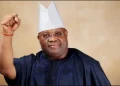


Former Benue State Governor and chieftain of the Peoples Democratic Party (PDP), Dr. Gabriel Torwua Suswam, has officially resigned from the party, marking another major blow to the already troubled opposition party ahead of the next general election.
Suswam’s resignation was conveyed in a formal letter dated February 4, addressed to the Chairman of Mbagber Council Ward in Logo Local Government Area of Benue State, his political ward.
The former governor cited prolonged internal crisis, lack of unity, and unresolved leadership disputes within the PDP as the primary reasons for his decision to quit the party he has belonged to for decades.
His exit adds to the growing list of influential politicians abandoning the PDP as internal wrangling continues to weaken the party’s structure nationwide.
Gabriel Suswam’s Resignation Letter: Key Highlights
In the resignation letter, Suswam expressed disappointment over the party’s inability to resolve its internal conflicts, stating that the situation had made meaningful political engagement impossible.
According to the former governor:
“I consider it honorable and necessary to step aside while wishing the party well should it one day find the courage and consensus to resolve its long-standing issues.”
Although Suswam did not explicitly state which political party he plans to join next, political observers and insiders have linked him to a coalition of opposition leaders that recently adopted the African Democratic Congress (ADC) as a platform for contesting upcoming elections.
Who Is Gabriel Suswam? A Brief Political Profile
Dr. Gabriel Torwua Suswam is one of the most prominent political figures to emerge from Benue State. His political journey includes:
-
Member, House of Representatives (1999–2007)
-
Governor of Benue State (2007–2015)
-
Senator representing Benue North-East (2019–2023)
-
Influential PDP stakeholder for over two decades
Suswam played a key role in shaping the PDP’s fortunes in Benue State and the North-Central region. His resignation is therefore seen as symbolic and strategic, not just personal.
PDP’s Lingering Crisis: The Core Reason for Suswam’s Exit
The PDP has been grappling with deep internal divisions since the 2023 general elections. These crises cut across several levels:
1. Leadership Crisis
Disputes over the legitimacy of party leadership at national and state levels have weakened cohesion. Multiple court cases and parallel executives have made coordination difficult.
2. Zoning and Power Struggles
Disagreements over zoning arrangements, especially concerning presidential and national offices, have fueled internal resentment.
3. Loss of Ideological Direction
Many party members complain that the PDP has lost its ideological focus, making it difficult to present a united front against the ruling party.
4. Defections of Key Stakeholders
Several governors, senators, and former ministers have either defected or openly distanced themselves from the party, further eroding confidence.
Suswam’s resignation reflects growing frustration among long-standing members who believe the party is failing to reinvent itself.
Suswam and the ADC Coalition: What We Know So Far
Although Suswam stopped short of announcing his next political destination, sources confirm his involvement with a coalition of opposition leaders seeking to build a formidable alternative ahead of future elections.
This coalition has reportedly adopted the African Democratic Congress (ADC) as its preferred platform.
Why ADC?
The ADC is increasingly attractive to opposition politicians because:
-
It is relatively free from legacy internal crises
-
It offers a neutral platform for alliances
-
It is open to reforms and restructuring
-
It allows equal participation without entrenched godfatherism
If Suswam officially joins the ADC, it could significantly strengthen the party’s profile in the North-Central region.
Political Implications for Benue State
Suswam’s resignation is expected to have serious consequences for Benue politics.


Impact on PDP in Benue
-
Possible mass defection of loyal supporters
-
Weakening of PDP’s grassroots structure in Logo LGA and beyond
-
Increased internal tension among remaining party leaders
Impact on Opposition Politics
-
Strengthening of third-force movements
-
Increased competition ahead of governorship and legislative elections
-
Realignment of political loyalties across local governments
Benue State has long been considered a PDP stronghold. Suswam’s exit may signal the beginning of a political realignment.
Reactions Trail Suswam’s Exit from PDP
PDP Loyalists
Some PDP members have described Suswam’s decision as “regrettable,” urging party leaders to urgently address internal divisions to prevent further damage.
Opposition Figures
Leaders within the ADC and other opposition groups have welcomed Suswam’s move, describing it as a bold and principled decision.
Political Analysts
Analysts believe Suswam’s resignation highlights the PDP’s struggle to retain experienced leaders and could encourage others to leave if reforms are not implemented.
A Growing Trend: PDP Leaders Leaving the Party
Suswam’s resignation is not an isolated case. In recent years, the PDP has witnessed:
-
Defections to APC
-
Movement to smaller parties
-
Formation of opposition coalitions
-
Political disengagement by senior figures
This trend raises questions about the party’s preparedness for future elections.
What This Means for Nigeria’s Opposition Politics
The exit of experienced politicians like Suswam could reshape Nigeria’s opposition landscape in several ways:
-
Emergence of Stronger Coalitions
Smaller parties may gain relevance through strategic alliances. -
Reduced PDP Dominance
The PDP may lose its status as the primary opposition party if the crisis persists. -
Increased Voter Choices
Voters may benefit from more competitive political platforms. -
Pressure for Internal Party Reforms
Parties will be forced to improve internal democracy to retain members.
Can PDP Still Recover?
Despite its challenges, political observers believe the PDP can still recover if it:
-
Resolves leadership disputes
-
Enforces party discipline
-
Rebuilds internal democracy
-
Reconnects with grassroots supporters
-
Presents a clear ideological direction
However, time is running out, and more defections could occur if decisive action is not taken.
What Next for Gabriel Suswam?
While Suswam has not officially declared his next political move, expectations remain high that he will:
-
Formally align with the ADC coalition
-
Play a leadership role in opposition realignment
-
Remain active in Benue and national politics
Given his experience, Suswam is likely to remain a key political force, regardless of party affiliation.
Conclusion
The resignation of former Benue State Governor Gabriel Suswam from the PDP marks another critical moment in Nigeria’s evolving political landscape.
His decision underscores the deep-seated crisis within the PDP and reflects broader dissatisfaction among party elites. As opposition coalitions gather momentum under platforms like the ADC, Nigerian politics may be heading toward a major reshaping ahead of the next election cycle.
For now, all eyes remain on Suswam’s next move and whether the PDP can halt the wave of internal discontent threatening its future.




![You’ll not go and marry’ — Jarvis blasts X user, Ruth over alleged body-shaming [VIDEO]](https://naijamixed.com.ng/wp-content/uploads/2026/08/Jarvis-1024x1024-1-120x86.jpg "You’ll not go and marry’ — Jarvis blasts X user, Ruth over alleged body-shaming [VIDEO] 11")